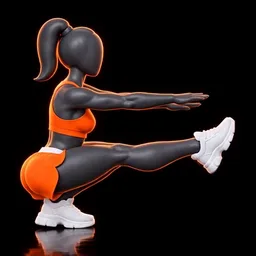
The bulgarian split squat is a single-leg squat where your back foot rests on a chair or bench behind you. It mainly trains your quads and glutes, and it also challenges balance. It suits people who already squat and lunge comfortably and want a harder leg exercise that needs no equipment beyond a sturdy chair.
You may also see it called a bulgarian squat, and people often search for bulgarian split squats in the plural. It is all the same move: one leg works while the other mostly stays out of the way.
How to do a bulgarian split squat
The app teaches this in three steps. Here they are with more detail.
- Set up the chair. Place a sturdy chair against a wall so it cannot slide. Stand with your back to it, about two feet (60 cm) away to start.
- Place your rear foot. Rest the top of one foot, or your toes, on the seat behind you. Keep the rear foot on the chair for the whole set.
- Find your front foot position. Your front foot should be far enough forward that, at the bottom, your front knee stays roughly over your ankle. Stand tall, chest up, with your hands on your hips or in front of your chest.
- Lower with control. Bend both knees and lower your back knee toward the floor. Go straight down, not forward. Stop when your front thigh is parallel to the floor and your back knee nearly touches the floor.
- Drive up. Press through your front heel to stand back up. Think of pushing the floor away with that front foot.
- Finish the set, then switch. Complete all your reps on one leg, then switch legs. The reps in the app are counted per side.
Keep every rep slow and controlled, with the same leg working the whole set. There is no jumping in this move.
Tip: Lean slightly forward from the hips to target your glutes more. Keep your back long, not rounded.
Muscles worked
People often ask whether this is a compound or isolation exercise. It is compound: it moves your hip and knee together and uses several muscle groups at once.
- Quadriceps: the front of the thigh does much of the work as you stand up.
- Glutes: they drive the hips forward, especially if you lean slightly forward or take a longer stance.
- Hamstrings and inner thighs: they help control the movement and keep you steady.
- Calves and core: they work to keep you balanced on one leg.
The app counts it as a strength move that mainly trains the legs and glutes. Exercising one area does not burn fat from that spot, but strong legs make everyday movement easier.
For energy use, the app lists about 74 kcal in 10 minutes of work for a 70 kg (154 lb) person (MET 6). Your own number will differ.
Common mistakes and how to fix them
Your front foot is too close to the chair
This pushes your front knee far past your toes and loads the knee. Take a bigger step forward so your shin stays fairly upright at the bottom.
You tip or twist sideways
If your hips swing or your front knee caves in, slow down. Point your front knee in line with your toes and keep your hips square.
You do not go deep enough
Aim for a parallel front thigh. If balance stops you, hold a wall or door frame with one hand and lower only as far as you can control.
Your weight rolls onto your toes
Driving from the toes makes the move wobbly. Keep your whole front foot on the floor and push through the heel.
You bounce out of the bottom
The move should be smooth. Pause for a beat at the bottom, then stand up with control.
The chair slides
A moving chair is a fall risk. Use a heavy chair, push it against a wall and check that the seat is stable.
Easier and harder variations
This is an advanced move in the app, so many people need a stepping stone.
Easier options
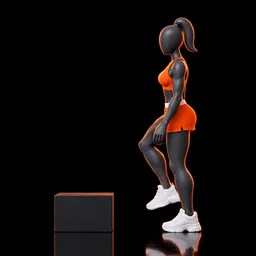
- Step-Ups: a single-leg move with less balance demand.
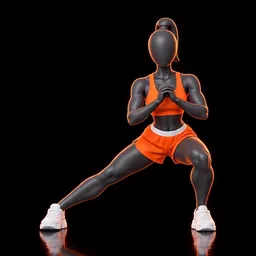
- Side Lunges: they train the legs from a different angle with both feet on the floor.
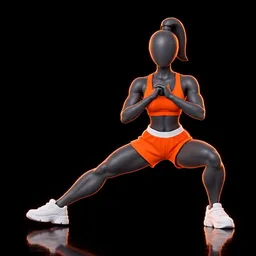
- Cossack Squat: a wide, side-to-side squat that builds hip and leg strength.
Similar or harder moves
- Skater Squat: a single-leg squat where the back foot hovers.
- Pistol Squat: a full one-leg squat and a big step up in difficulty.
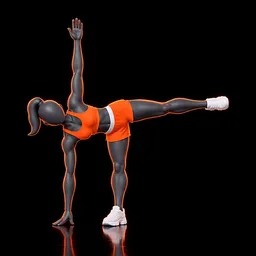
- Half Moon: a balance-focused move that also challenges one leg at a time.
You can also make the split squat itself harder by slowing it down, for example taking three seconds to lower.
Sets and reps
The app uses 10 reps per side per side as its standard at intermediate level. Beginners get about a quarter less, and advanced users about a third more.
As a starting point:
- Beginners: 2 sets per side, using the lower beginner count from the app. Hold a wall for balance if needed. Rest 45 to 60 seconds between sets.
- More advanced: 3 sets per side using the higher advanced count. Rest 30 to 60 seconds. Slow your lowering or add a short pause at the bottom before you add anything else.
Train both sides equally. If one leg is weaker, start with that one and match the reps on the other.
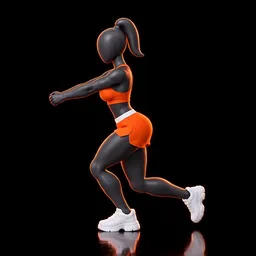
It helps to warm up first with Leg Swings or Hip Circles. If you are new to squatting, build a base with Squats and Reverse Lunges.
If you want feedback, Homie Fit has a live form check for this exercise. The camera counts your reps and checks your form on the phone, so no video leaves your device.
Who should modify or skip it
- Sensitive knees: the app swaps this move for a safer one when someone reports sensitive knees. If you feel sharp or pinching knee pain, stop and choose an easier option such as Step-Ups or Side Lunges.
- Balance problems: hold a wall, or practice the easier options first.
- Beginners: the move is rated advanced, so build up gradually.
- Pain or injury: if you have an injury or ongoing pain, check with a health professional before trying it.
Mild muscle effort and a burn in your thigh are normal. Sharp pain is not, so stop if you feel it.