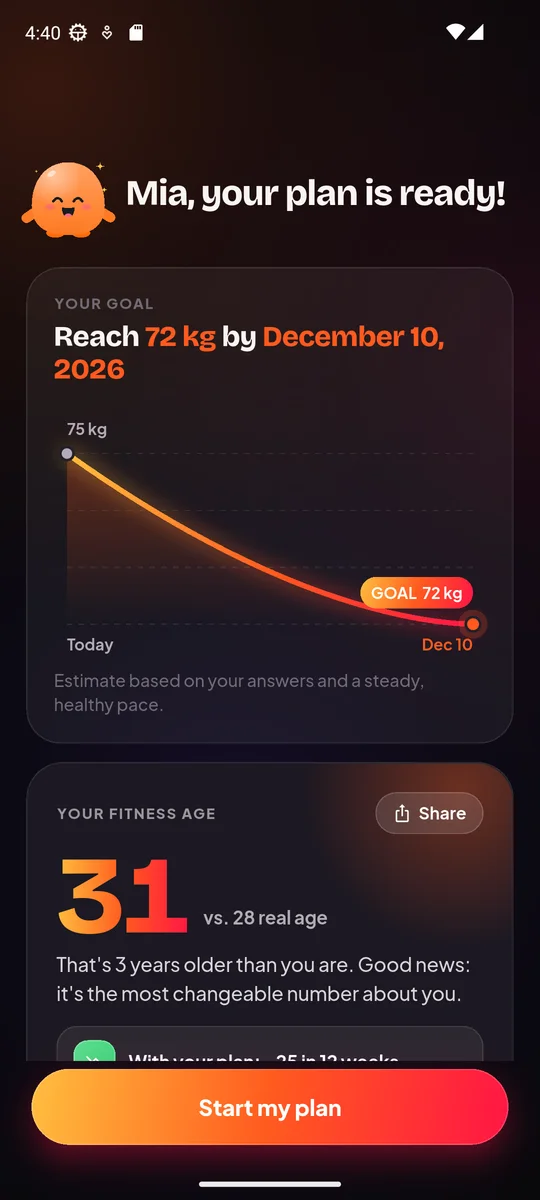
This fitness age calculator gives you a quick estimate of how fit you feel compared with your real age. It uses the same logic as the Homie Fit onboarding, runs in your browser, is free, needs no sign-up, and nothing you enter is uploaded.
Think of it as a friendly fitness age test, a bit like a body age calculator or a short fitness age quiz. It takes about a minute and gives you a number to beat, not a verdict.
How to use the fitness age calculator
- Enter your age, height and weight. The calculator uses height and weight to work out your BMI.
- Pick how active you are: mostly sitting, lightly active, active, or very active.
- Choose how many push-ups you can do: 0 to 5, 6 to 15, 16 to 30, or 30+.
- Select your usual sleep: under 5 hours, 5 to 6 hours, 7 to 8 hours, or more than 8 hours.
- Tell it when you were last in good shape: under a year ago, 1 to 2 years ago, 3+ years ago, or never.
- Read your fitness age, plus where it could be after 12 weeks of steady training.
For the push-up question, count the reps you can do with steady form, using whichever version you normally train with. Be honest rather than hopeful. The number is only useful if it reflects where you are today.
How it works
The logic is simple addition and subtraction. Your fitness age starts at your real age. Each answer then adds or removes years.
Activity
Mostly sitting adds 4 years. Lightly active adds 1. Active takes off 2. Very active takes off 4.
Push-ups
The push-up question works the same way: 0 to 5 adds 4 years, 6 to 15 adds 1, 16 to 30 takes off 2, and 30+ takes off 4.
Sleep
Under 5 hours adds 3 years. 5 to 6 hours adds 1. 7 to 8 hours takes off 1. More than 8 hours adds 0.
BMI
BMI is your weight relative to your height. Under 18.5 adds 2 years. 18.5 to 25 takes off 1. 25 to 30 adds 2. 30 and above adds 5.
Last time in good shape
Under a year ago takes off 1 year. 1 to 2 years ago adds 0. 3+ years ago adds 1. Never adds 2.
The limits on the result
The final number stays between 12 years under your real age and 15 years over it. It also never goes below 16.
The 12-week projection
The calculator also shows where your fitness age could land after 12 weeks of steady training. That is up to 6 years lower, but never below your age minus 4, and never below 16. It is a possibility to aim for, not a promise.
How to read your result
If your fitness age is lower than your real age, your habits are working in your favor. Keep what you are doing and look at the answer that cost you the most years for your next step.
If it is higher than your real age, take it as a map, not a judgment. Each answer you can improve is a lever. Most people have at least one that is easy to move.
- Activity and push-ups respond to regular training. Walking more, adding short strength sessions and building up reps all help.
- Sleep is the quiet one. A steady bedtime can shift this answer without any gym time.
- BMI is a rough ratio of weight to height. It does not see muscle, bone or where weight sits, so treat it as one input among several.
- Last in shape only changes with time, but starting counts: once you train steadily, the answer shifts.
A common question is how many push-ups you should be able to do. There is no single right number. The calculator groups the answer into four bands, so use the band you are in as a starting point and aim for the next one. If full push-ups are hard, incline push-ups against a counter are a fair way to build up.
Another frequent question is whether a heart rate of 170 is good during a workout. That depends on your age, fitness and health, and this calculator does not measure heart rate. If you are unsure what is right for you, ask a health professional.
Limits and accuracy
This is an estimate, and a playful one. It is a motivation score, not a medical test. It cannot measure your heart, lungs, blood pressure, strength or health conditions.
It uses only seven inputs, and each one is a broad band. Two people with the same answers can be quite different in real life. BMI in particular does not account for muscle or body shape.
It also cannot tell you what predicts how long you will live. Think of the number as a nudge for habits you can change: moving, strength, sleep and consistency. If you have health concerns, chest pain, dizziness or a medical condition, talk with a doctor before you start a new routine.
For a fuller picture of your body, a body fat percentage chart and a careful waist measurement give extra context that BMI misses.
What to do next
Pick one or two answers to improve and build a routine around them. A solid starting point is 2 to 3 strength sessions a week with rest days between, plus easy walking on the other days.
- Build the push-up and strength side with the calisthenics workout at home.
- Want a plan built for you? The workout generator makes a free home plan in your browser.
- Need a lower-body day? Try the glute workout at home or learn the goblet squat.
- Want a simple daily habit? The 30 day plank challenge gives you one small target each day.
If you like having a plan that adapts, Homie Fit builds a 4-week home plan from a short setup and adjusts after your “too easy” or “too hard” feedback. Come back and retest after about 12 weeks of steady training to see how your answers have moved.