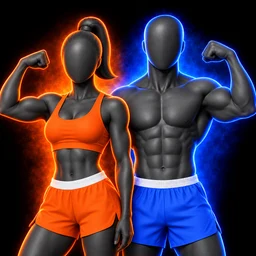
A body fat percentage chart shows how much of your body weight is fat, and sorts that number into general categories. If you have been searching for a body fat chart, a body fat percentage chart for men, or body fat percentage pictures, the figures and table above give you both: a visual and a set of ranges. This page explains how to read them, how to use them for yourself, and where they stop being useful.
A quick note before we start: a number on a chart is information, not a verdict on you. It describes one part of how your body is built.
What body fat percentage means
Body fat percentage is the share of your total weight that is fat tissue. The rest is muscle, bone, organs, water and everything else. If you weigh 180 pounds (82 kg) and 20% of that is fat, then about 36 pounds (16 kg) is fat.
Some fat is not optional. Your body needs it for hormones, protecting organs, absorbing certain vitamins and storing energy. That is why the chart starts with a category called essential fat, and why lower is not automatically better.
The general categories
The table above uses categories from the American Council on Exercise. Here they are written out so you can compare them side by side.
| Category | Men | Women |
|---|---|---|
| Essential fat | 2-5% | 10-13% |
| Athletes | 6-13% | 14-20% |
| Fitness | 14-17% | 21-24% |
| Average | 18-24% | 25-31% |
| Obese | 25%+ | 32%+ |
Women’s ranges are higher than men’s. This is normal biology, tied to hormones and reproductive health, and not a sign that something is wrong.
These are general categories. They are a way to organize numbers, not a pass or fail test. Where you land on the table does not tell you how healthy, strong or capable you are.
Reading the visual chart
The stylized figures above show men at 8, 12, 15, 20, 25, 30 and 35% body fat, and women at 15, 20, 25, 30, 35, 40 and 45%. They are illustrations, not photos. That matters, because a real body at any of these numbers can look different.
Here is why a body fat percentage visual is only a rough guide:
- Fat is stored differently. Some people carry more around the middle, others in the hips and thighs. The same percentage can look different on two people.
- Muscle changes the picture. More muscle can make the same percentage look firmer or fuller.
- Height, frame and posture matter. Lighting and camera angle can change how a body looks in a photo too.
Use the figures to get a general sense of the scale, not to decide which one “you” are. If you want to see how your own proportions might change with training, the Body Visualizer is a gentler way to explore that than hunting for lookalike photos.
Body fat percentage chart for men: common questions
Is 20% fat good for men?
On the table above, 20% falls in the average range for men (18-24%). It is not an alarming number. Whether it is “good” depends on your health, your energy, how you feel and what you want from your training. If it is your starting point, a steady routine of strength work and daily movement is a sensible place to begin.
What is the most attractive body fat percentage for a guy?
There is no single answer, because attractiveness is personal and varies a lot between people and cultures. Chasing a number someone online calls ideal often backfires. A better goal is a range where you feel strong, energetic and able to keep up your habits without strain. For many men the athletes and fitness ranges on the chart are realistic reference points, but they are not required.
Women and the higher numbers
For women, the chart’s fitness range is 21-24% and the average range is 25-31%. If you are wondering whether 29 percent body fat is bad, it falls in the average range for women on this table. That is a common, ordinary place to be. For a man, 29% would sit above the average range, which is one more reason to compare yourself only with the column that applies to you.
The key point is that no single percentage is “bad” in isolation. Health depends on many things: how active you are, how you sleep, what your doctor sees in your bloodwork and more. If you are concerned about a number, a healthcare professional can put it in context.
Does muscle weigh more than fat?
Not exactly. A pound of muscle weighs the same as a pound of fat. The difference is density: muscle takes up less space than fat for the same weight. That is why two people at the same weight can look quite different, and why the scale alone can mislead you when you start strength training.
If your weight stays the same while your clothes fit differently, that is a good reason to track more than one thing.
How to estimate body fat at home
There is no perfect home method. Every option has a margin of error, so think of results as estimates and focus on direction over time.
Waist measurement
Your waist is one of the simplest things to track, and it needs only a soft tape measure. Measure at the same spot, at the same time of day, relaxed and not pulling the tape tight. Our guide on how to measure your waist walks through the steps for accuracy.
Progress photos
Take photos in the same lighting, same pose and same clothes, about every few weeks. Compare them side by side rather than looking in the mirror daily, where small changes are hard to see. The progress photos feature in Homie Fit includes a before/after slider for exactly this kind of comparison.
Smart scales and handheld devices
Many scales and handheld devices estimate body fat by sending a tiny electrical signal through your body. Results shift with hydration, recent meals and exercise. They can be useful if you measure under the same conditions each time, such as first thing in the morning, but treat the exact number loosely.
Skinfold calipers
Calipers pinch folds of skin at set spots. They depend heavily on technique, so results from home use can vary. If you try them, have the same person take the same measurements each time.
Whichever you choose
- Pick one method and stick with it.
- Measure under the same conditions each time.
- Look at trends over weeks, not day-to-day changes.
- Pair numbers with non-scale signs, such as strength, stamina and how your clothes fit.
The limits of the numbers
A body fat percentage chart is a helpful map, but it leaves a lot out.
- Methods disagree. Different tools can give different numbers for the same person on the same day.
- Age and body type matter. Categories are general and do not account for your history, genetics or stage of life.
- Fitness is more than fat. Strength, mobility, heart health and sleep matter too. If you want another angle, the Fitness Age Calculator looks at fitness rather than just body composition.
- Lower is not always healthier. Pushing below the range your body is comfortable in can affect energy, mood and hormones.
Exercise also cannot target fat in one spot. Crunches do not burn belly fat, and arm exercises do not remove fat from your arms. Your body decides where fat comes from. What exercise does is build muscle and support overall health, which is worth doing whatever the chart says.
How to train at home with body composition in mind
You do not need to chase a percentage. Build a routine you can keep, and let the numbers follow your habits rather than drive them.
Build muscle with strength work
Resistance training helps you maintain and build muscle, which supports a firmer, stronger look at any body fat level. A reasonable starting point is 2 to 3 sets of 8 to 12 reps, 2 to 3 days per week, resting 30 to 90 seconds between sets. Good choices for home include:
- Goblet Squat for legs and core
- Glute Bridge for glutes and hamstrings
- Dumbbell Shoulder Press for shoulders and arms
If you want a ready structure, the Workout Generator can put together a session around what you have at home.
Add cardio you enjoy
Walking, dancing, bodyweight circuits and intervals all raise your activity level. Pick what you will actually do. If you are curious how much a session might use, the Calories Burned Calculator gives an estimate for home workouts.
Be patient and consistent
Body composition changes slowly and unevenly. Aim for steady habits: regular training, enough protein and vegetables, decent sleep and daily movement. If you want a plan that adjusts as you go, Homie Fit builds a 4-week home plan from your goal, equipment and training days, and adapts after your “too easy” or “too hard” feedback.
A simple way to use the chart
- Find your row on the table for your sex, and look at the figures above to get a general feel.
- Pick one tracking method and take a baseline measurement.
- Track waist, photos or strength every few weeks.
- Decide on a goal based on how you want to feel and perform, not only on a number.
- Check in with a healthcare professional if you have questions about your health.
The bottom line
Use a body fat percentage chart as a rough guide, not a score. Your ranges are one piece of a bigger picture that includes strength, energy, sleep and habits. Measure the same way each time, look at trends, and train in a way that you can keep doing.