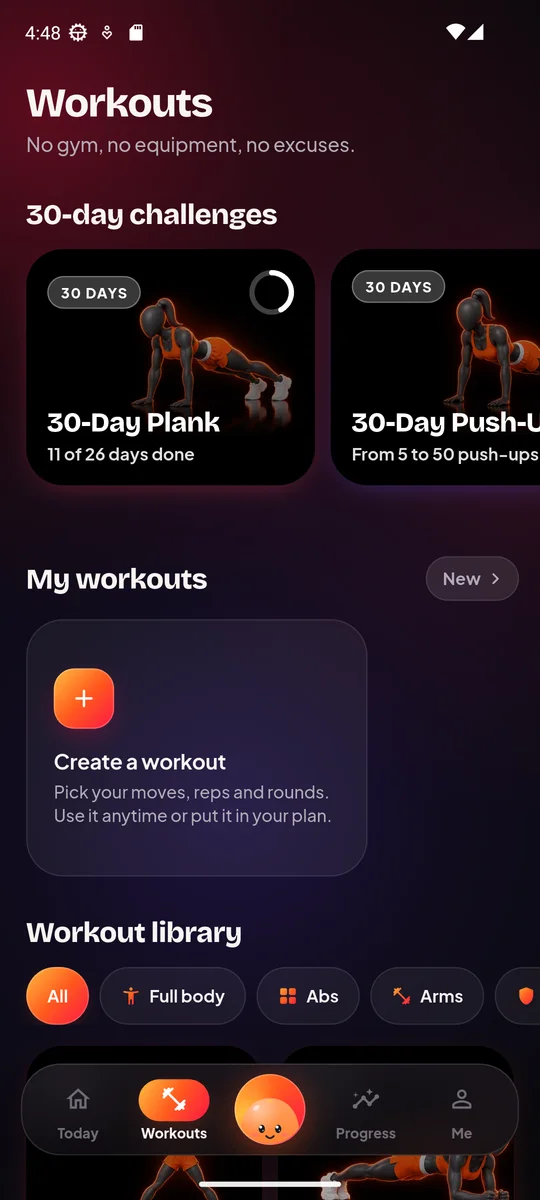
This plank challenge is a 30-day plan built around one forearm plank hold per day. You start at 20 seconds on day 1 and build up to 5 minutes on day 30. Every 7th day is a rest day, so you get 4 rest days along the way. The calendar above shows every daily target, and you can print it and cross off each day.
How the 30 day plank challenge works week by week
The targets rise evenly across the active days and are rounded to 5 seconds. That means no big jumps. Most days ask for only a little more than the day before.
- Week 1 (days 1 to 7): You begin at 20 seconds and add a bit each day. Day 7 is a rest day. Use this week to learn the position and find your breathing rhythm.
- Week 2 (days 8 to 14): The holds get noticeably longer. By day 13 you reach 2:25 minutes. Day 14 is a rest day.
- Week 3 (days 15 to 21): This is where it starts to feel like real work. Keep your form tidy and take the rest day seriously.
- Week 4 (days 22 to 30): Day 28 is a rest day. The last two days finish the climb, and day 30 is your 5 minutes target.
There is only one hold per day, and it is timed. Check the calendar each morning so you know your number before you start.
How to do the forearm plank right
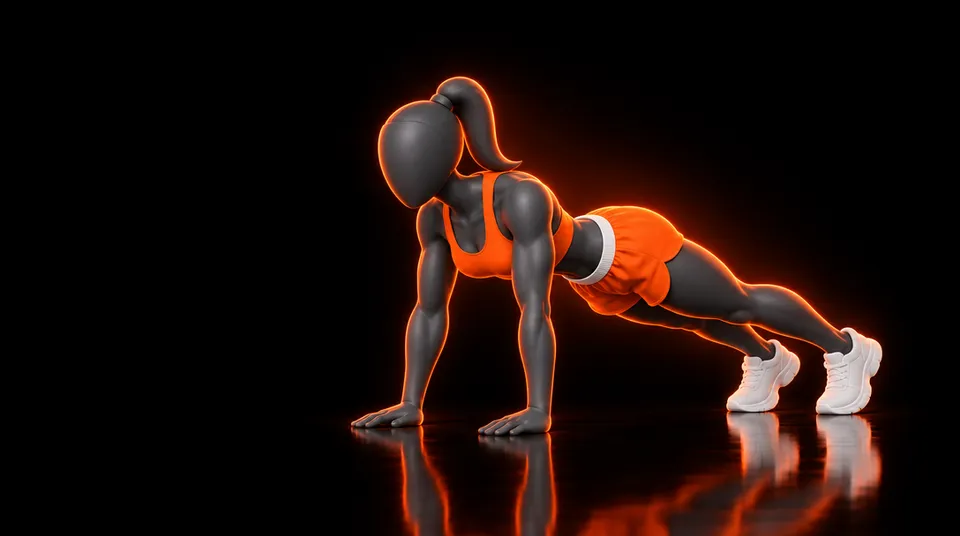
The forearm plank is an isometric hold. Your body stays still while your muscles work, and your breathing stays calm and steady. Here is how to do it, and you can see the movement in the Forearm Plank guide.
- Place your forearms on the floor with your elbows directly under your shoulders.
- Extend your legs behind you and lift your body into one straight line from head to heels.
- Hold the position, squeezing your glutes and core.
- Breathe slowly and evenly. Do not hold your breath.
The main tip: don’t let your hips sag or pike up. If you can’t keep a straight line, the hold is over for now, even if the clock is still running. A shorter clean hold is worth more than a longer sloppy one.
A mat under your forearms helps on hard floors. If you want a second opinion on your form, the live AI form check in Homie Fit uses your phone camera and gives feedback on form, and it runs on the device, so no video or image leaves your phone. Check the exercise list in the app to see if the plank is one of the 83 supported exercises.
How to split the daily target into sets
The challenge calls for one hold per day, and that is the goal. But you can reach that target in pieces when your form starts to fade. Here is a simple way to think about it.
- Try the full hold first. Start the timer and go until you reach the target or your form breaks.
- If your form breaks early, rest and finish. Rest 30 to 60 seconds, then do another hold for the remaining time. Repeat if needed.
- Keep the pieces honest. Each piece should be a clean plank, not a wobbly one.
When the targets get longer in weeks 3 and 4, splitting into two or three sets is a perfectly reasonable way to finish the day. It still counts as completing the day. As you get stronger, aim for fewer pieces. On day 30 you can try to do it all in one go, but it is not required.
What to do when you miss a day or it gets too hard
Life happens. Missing a day is not a failure, and there is no guilt here.
If you miss a day
Pick up where you left off. Do the missed day’s target and carry on. If you missed two or more days in a row, step back to the target from a few days earlier and build up again. Your body adapts to what you do regularly, so a gentler restart is smart rather than a setback.
If a target feels too hard
- Repeat the day. Stay on the same target for a second day before moving up. It is fine to stretch the calendar.
- Split the hold. Use sets with 30 to 60 seconds of rest.
- Make the position easier. Hold from your knees while you build strength, then return to the full forearm plank. Note that a knee plank is an easier version, not the same move, so aim to come back to the full version.
- Check for pain. Mild muscle fatigue is normal. Sharp pain in your lower back, shoulders or wrists is a signal to stop. If it continues, talk with a healthcare professional.
Swapping in some supporting moves can also help. A few glute bridges teach you to squeeze your glutes, which is part of a solid plank.
What you can realistically expect after 30 days
Nobody can promise exact results, and bodies respond differently. Here is what is reasonable to hope for.
- Better plank endurance. If you follow the calendar, you practice holding for longer each week.
- More awareness of your posture. Many people get better at feeling when their hips drop or their ribs flare.
- A habit. Thirty days of showing up is a solid base for what comes next.
What a plank challenge cannot do is burn fat from your waist. Exercise for one body part does not remove fat from that spot. Planks train your core muscles, and that is a different goal. If you are curious about your waist measurement for tracking purposes, see how to measure waist for simple steps.
Once you finish, you might move on to other challenges, like the 30-day abs challenge or the 30-day wall sit challenge, which are also built around steady daily targets.
Tips to stay consistent
- Pick a set time. Right after brushing your teeth or before a shower works well because it is hard to skip.
- Print the calendar. Crossing off each day gives you a small win. In Homie Fit, the challenge has a day grid that tracks every finished day, and streaks are not broken by rest days.
- Use a timer, not a guess. A phone timer or a clock in view keeps the hold honest.
- Keep it short. Even the longest day is only a few minutes. Do it before you can talk yourself out of it.
- Respect rest days. The rest day on every 7th day is part of the plan. Your muscles and tendons adapt while you recover.
- Warm up first. A minute of arm circles and shoulder rolls loosens your shoulders before you get into position.
- Focus on form. Squeeze your glutes, keep your ribs down, and breathe. If the line breaks, end the hold.
Show up, hold a straight line, and let the calendar do the planning.